Bovada · as of September 5, 2026
UNLV defeated Hawai'i 21–6 in a double-digit victory. UNLV covered by 12.0; Game went Under by 28.5. The market closed at UNLV -3.0 and the Blue Chip model made it Hawai'i -0.4, an edge of 3.4 points toward Hawai'i.
Memphis sacked Jackson Arnold six times and recorded 11 tackles for loss, repeatedly collapsing the pocket on fourth down to force a turnover on downs that sealed the game. The offensive line, featuring Austin Boyd moving to center and Will Thomas at left tackle, struggled to handle pressure all night. Hawai'i, though not as talented as Memphis, will scheme blitzes and stunts to exploit this weakness, especially on obvious passing downs. If UNLV cannot shore up protection, Arnold's effectiveness will be limited and the offense will stall, putting more pressure on a defense that already gave up 27 points.
In the opener, Memphis scored on a 48-yard touchdown pass and a 36-yard run, exposing a defense that returned only one starter per level. The secondary, despite transfers like Kyron Chambers and Tony Louis-Nkuba, was beaten over the top, and the front seven struggled to contain outside runs. Hawai'i, coming off a loss, will look to create big plays through the air and on the ground to keep the Rebels off balance. If UNLV cannot tighten coverage and gap discipline, Hawai'i can keep this game close or pull ahead, especially with the home crowd behind them.
UNLV played its opener in a climate-controlled dome at home, but now travels over 2,700 miles to Hawai'i, a notoriously difficult road trip that includes time zone changes and a raucous stadium. Hawai'i's home-field advantage is among the strongest in the Group of Five, and the Warriors are desperate for a win after an 0-1 start. UNLV's young defense and new quarterback will face their first true road test, and the travel fatigue could slow the offense early. The market's modest confidence in UNLV does not fully account for the cumulative effect of this travel and hostile environment.
The betting line and prediction market favor UNLV by a small margin, but that confidence seems to rely on last season's 10-win campaign and the departure of Boise State from the conference. However, the Rebels lost their star quarterback, have a rebuilt defense that was porous against Memphis, and now face a long road trip. Hawai'i, despite its own loss, has a returning quarterback and a defense that can pressure the pocket. The market's edge for UNLV is thin and does not fully reflect the team's unresolved offensive line issues and defensive inexperience, making Hawai'i a live underdog at home.
After trailing 23-7 entering the fourth quarter at Stanford, Hawai'i scored three touchdowns in the final period, with Micah Alejado throwing two scores and DeVon Rice catching the go-ahead 29-yarder. Alejado finished 30-of-50 for 269 yards and two touchdowns, and the offense moved the ball consistently against a Power Four defense. UNLV is also 0-1 and its defense is not a proven unit, so Hawai'i's quick-strike spread, built around Alejado and slot receivers Pofele Ashlock and Audric Harris, should find room. The market's total is high, reflecting this, but the offense's demonstrated ability to score in bunches is the clearest path to covering or winning outright.
Hawai'i returned only three defensive starters, lost two all-league defensive linemen, and is without linebacker Jamih Otis (ACL). At Stanford, the unit allowed 310 passing yards and three rushing touchdowns, and a botched punt return led to a safety, showing both talent and discipline gaps. UNLV, despite its own loss, has a more settled offensive identity and will test Hawai'i's young front seven. The market's lean toward UNLV is built on this asymmetry, and it is justified: Hawai'i's defense has not shown it can stop a competent offense, and UNLV is that.
Hawai'i's home-field advantage is among the strongest in the Mountain West, and the team hosts three conference contenders this season partly because of it. After a 2,400-mile road trip to Stanford, Hawai'i returns to Honolulu with no travel and eight days of rest, while UNLV is coming off its own game but must travel to the islands. The venue's home-field value is substantial, and the culture under Timmy Chang is built on playing hard at home. The market's line favors UNLV by a modest margin, but the combination of no travel, extra rest, and a raucous home crowd could narrow that edge more than the line suggests.
The betting line and prediction market both favor UNLV by a moderate margin, reflecting Hawai'i's defensive inexperience and UNLV's stronger power rating. However, the market may be underrating how explosive Hawai'i's offense can be when Alejado is in rhythm, as shown by the fourth-quarter comeback at Stanford, and the real home-field advantage in Honolulu. The gap between the two teams' power ratings is not overwhelming, and Hawai'i's proven quarterback play gives them a live chance. The market is not wrong to favor UNLV, but the confidence in that edge is slightly higher than the on-field matchup justifies.
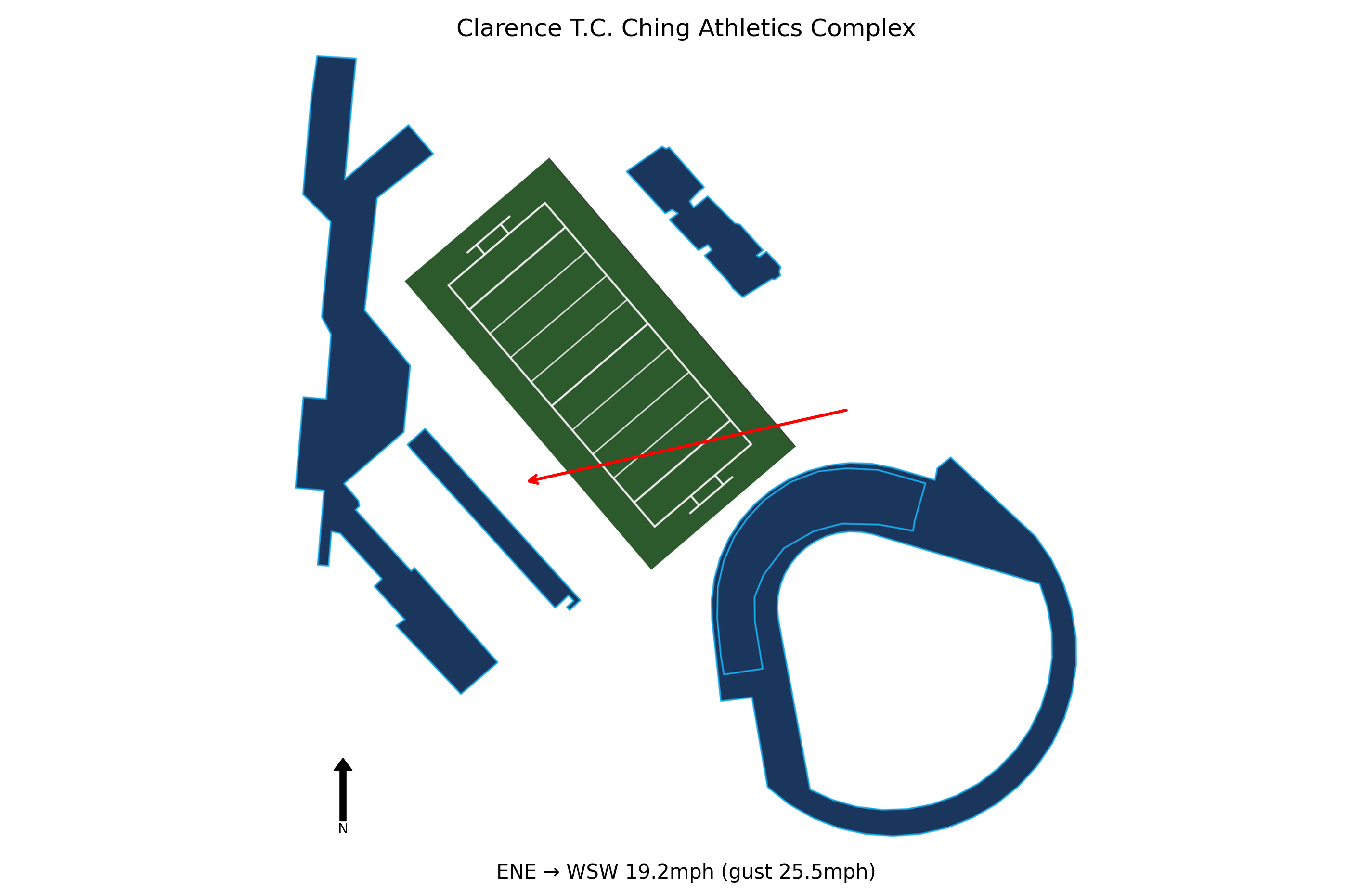
At kickoff, conditions at Clarence T.C. Ching Athletics Complex were Patchy rain nearby, 79°F with winds of 22 mph. Wind of 22 mph is enough to matter to the total: the market has historically taken about 1.7 points off the number in this band. It is worth re-checking closer to kickoff. Gusts reaching 22 mph add variance to the kicking and passing game. Games with gusts at or above 30 mph have seen the total move down by about 1.4 points. Historical weather data for this game is preserved in the panel alongside. Weather data is sourced from WeatherAPI.com.

Patchy rain nearby
79°F
| Measure | UNLVAway | Hawai'iHome |
|---|---|---|
| This week | 2,756 miles | 0 miles |
| Last week | Home game | 4,802 miles |
| Season total | 2,756 miles | 4,802 miles |
| Body clock | 19:00 | 16:00 |
| Rest | 7 days | 8 days |


.png)


