Bovada · as of August 29, 2026
USC defeated San José State 42–26 in a double-digit victory. San José State covered by 22.5; Game went Over by 6.5. The market closed at USC -38.5 and the Blue Chip model made it USC -35.2, an edge of 3.3 points toward San José State.
The Spartans return only two starters on defense and are breaking in a new defensive coordinator, Bojay Filimoeatu, after allowing the Mountain West's second-highest passer rating and tying for a league-low seven interceptions last season. Key contributors like corner Greco Carrillo and linebacker Zane Carter are returning from injuries that cost them all of 2025, and the defensive line is led by Justin Stearns, who has just six career starts. Against a USC offense with elite skill talent, this unit is the clearest liability and the primary reason the market has set such a lopsided line.
San José State was second in the Mountain West in passing offense last year and has produced the nation's leading receiver in each of Ken Niumatalolo's first two seasons, but the offensive line returns only two starters and the quarterback job is unsettled among Robert McDaniel, Luke Weaver, and Daniel Rolovich. The Spartans threw 17 interceptions a year ago, and facing a USC defense with superior athletes and a strong pass rush, the risk of turnovers and pressure is high. The system has a track record of production, but this matchup is a severe step up in competition.
The prediction market gives San José State a minimal chance to win, and the betting line is among the largest of the season. This reflects not just USC's home-field advantage and superior power rating, but also the Spartans' 3-9 record last year and the fact that they are starting over on both sides of the ball. While the preseason scouting from a Mountain West assistant suggested a bounce-back year, that optimism is about conference play, not a Week 0 road game against a top-tier opponent. The market's skepticism is well-founded.
San José State travels only a short distance to USC, which minimizes fatigue and is a mild positive, but the Spartans have no rest advantage and are playing in a hostile road environment with a significant home-field edge for USC. The Spartans' season travel is minimal at this point, but that is irrelevant against a team with far more talent and depth. The situational factors are not enough to narrow the gap.
Jayden Maiava returns as one of the nation's most efficient quarterbacks, but his top three targets from last season are gone. The new group, led by Tanook Hines and NC State transfer Terrell Anderson, plus freshmen Boobie Feaster and Mark Bowman, has talent but no proven production at this level. San José State's defense is far below Big Ten caliber, so this is a chance for the new receivers to establish chemistry, but early-season timing issues could limit explosive plays even in a blowout.
All five starters return on the offensive line, anchored by tackles Elijah Paige and Justin Tauanuu, and the backfield duo of Waymond Jordan and King Miller averaged over six yards per carry last season. San José State's front seven is not equipped to handle that kind of size and experience. Expect USC to control the clock and wear down the Spartans, which will also protect Maiava and allow the new receivers to settle in.
The line is set at a level that assumes USC will name its score, and the prediction market gives the Trojans an overwhelming win probability. That is justified by the roster disparity, but the market may be overconfident in a team that is breaking in a new receiving corps, a new defensive coordinator, and several transfers. San José State is a heavy underdog, but early-season sloppiness is common, and USC's offense could take a quarter or two to find its rhythm. The direction of the market is toward USC, but the strength of that confidence is slightly higher than the team's actual readiness justifies.
USC opens at home with no travel, a comfortable venue, and a full roster of returning starters on the offensive line. That is the ideal setup for a team with playoff aspirations. However, the lack of prior game action means rust is a real factor, and the coaching staff will likely use this game to experiment with rotations and packages rather than run up the score. The result should be a comfortable win, but the margin may not reflect the full talent gap if USC pulls its starters early.
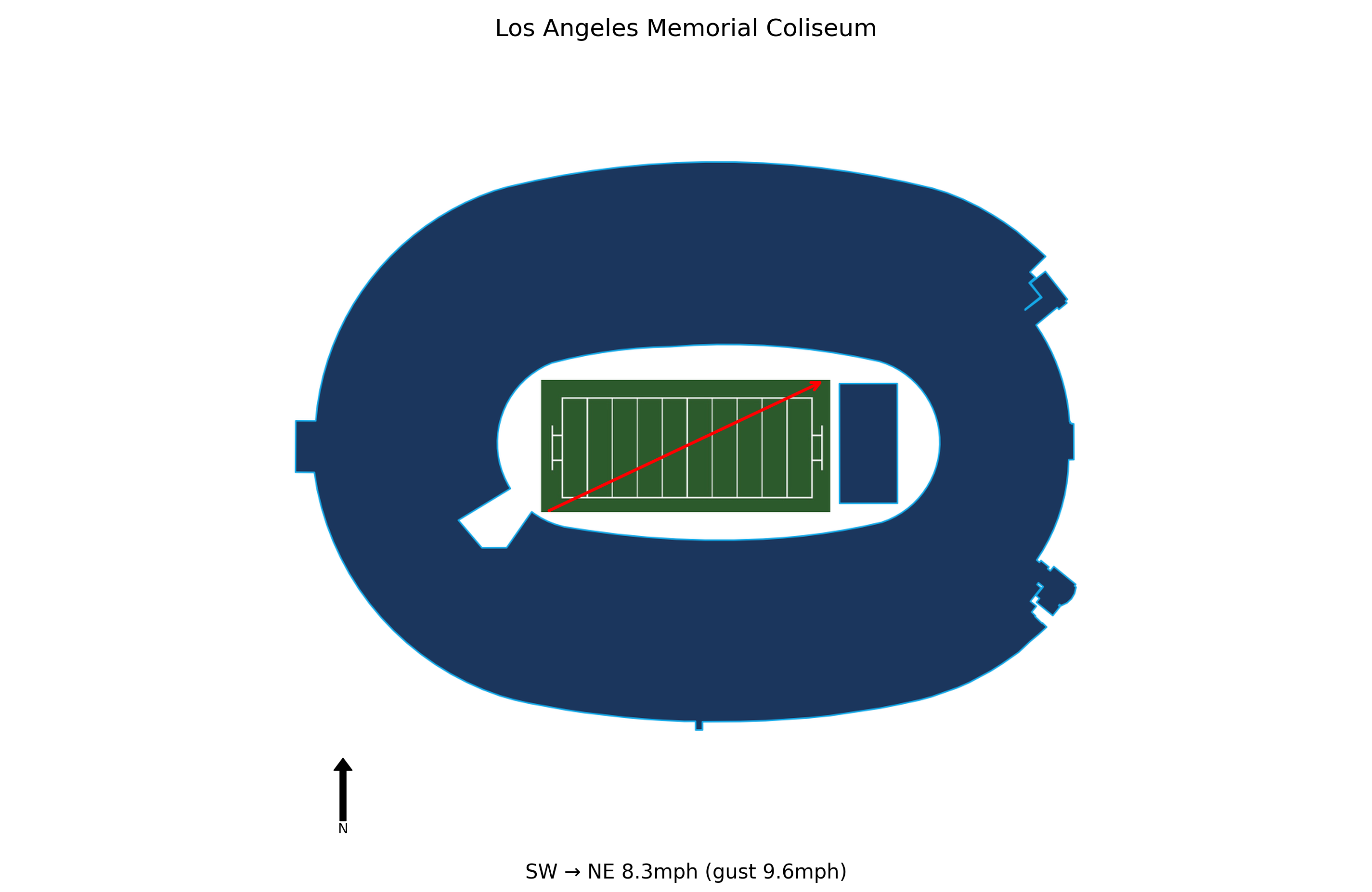
At kickoff, conditions at Los Angeles Memorial Coliseum were Smoky haze, 101°F, heat index 110°F with winds of 7 mph. Heat of 101°F is a conditioning factor, particularly in the second half, and the market has historically charged nothing for it. Historical weather data for this game is preserved in the panel alongside. Weather data is sourced from WeatherAPI.com.

Smoky haze
101°F
| Measure | San José StateAway | USCHome |
|---|---|---|
| This week | 304 miles | 0 miles |
| Last week | Season opener | Season opener |
| Season total | 304 miles | 0 miles |
| Body clock | 12:00 | 12:00 |
| Rest | Season opener | Season opener |


.png)


