Bovada · as of August 29, 2026
Stanford defeated Hawai'i 37–27 in a double-digit victory. Stanford covered by 6.0; Game went Over by 15.5. The market closed at Stanford -4.0 and the Blue Chip model made it Stanford -3.1. The two were within a point of each other, so there was no meaningful edge in this line.
Hawai'i returns only three starters on defense, with the defensive line losing two all-league players and linebacker Jamih Otis recovering from an ACL tear. The unit ranked sixth in the Mountain West last season and must now open against a Stanford team that, while also rebuilding, has a more settled offensive identity. The market's confidence in Stanford is built on this asymmetry: Hawai'i's defensive inexperience is the single biggest risk in this game, and it is not offset by any proven pass rush beyond Lesterlaisene Lagafuaina.
Alejado returns as the Mountain West Freshman of the Year, having averaged 282.4 passing yards per game with a 66% completion rate and 24 touchdowns. He operates in a four-wide spread that ranked eighth nationally in passing, and he has a reliable slot duo in Pofele Ashlock and Washington transfer Audric Harris. Stanford's defense is also in transition, and if Hawai'i can protect Alejado, the passing game should move the ball. This is the clearest path to an upset, and it is the reason the market's edge for Stanford is not overwhelming.
Hawai'i is flying roughly 2,400 miles one-way to Palo Alto, a trip that adds fatigue and disrupts routine. However, this program is accustomed to long travel, having logged nearly 30,000 miles in a typical season, and the team's culture under Timmy Chang is built on resilience. The venue's home-field advantage is modest, and Stanford is not a hostile environment like some Mountain West road trips. The travel factor is real but not decisive, and it is already baked into the market's line.
The betting line and prediction market both favor Stanford by a moderate margin, reflecting the home field and defensive concerns for Hawai'i. However, the market may be underrating how explosive Hawai'i's offense can be when Alejado is in rhythm, especially against a Stanford team that is also breaking in new pieces. The gap between the two teams' power ratings is narrow, and Hawai'i's proven quarterback play gives them a live chance. The market is not wrong to favor Stanford, but the confidence in that edge is slightly higher than the on-field matchup justifies.
Stanford's defense returns Matt Rose at linebacker and a deep safety room, but the unit is under a new coordinator and lost key pieces from a 2025 group that was strong in the red zone. Hawai'i's run-and-shoot style, which relies on quick, short passes and up-tempo pace, will test Stanford's communication and conditioning early in the season. The Cardinal's pass rush, led by Braden Marceau-Olayinka and Zach Rowell, must pressure Hawai'i's quarterback without blitzing excessively, because Hawai'i's quick game can punish aggressive coverage. This is a schematic mismatch that favors Hawai'i's ability to control the clock and keep Stanford's offense off the field.
Stanford's offensive line, anchored by Niki Prongos, Fisher Anderson, and Simione Pale, is experienced but unproven as a unit under a new coaching staff. Davis Warren, a transfer from Michigan, has a history of turnovers (nine interceptions in 2024) and will be a primary target for Hawai'i's blitz-heavy defense. Hawai'i's defensive front is not elite, but they will bring pressure to force Warren into mistakes. If Stanford can establish Micah Ford on the ground, it will slow Hawai'i's pass rush and set up play-action for Caden High and Benji Blackburn. The line's ability to handle stunts and delayed blitzes will be the difference between a comfortable win and a tight game.
Stanford opens at home with no travel, while Hawai'i travels across the Pacific to the mainland, a significant logistical hurdle. Stanford's venue home-field advantage is a known factor, and the Cardinal have historically been tough at home, especially in season openers. Hawai'i's travel fatigue, combined with the time zone change, can lead to slow starts and mental errors. Stanford's rest is equal, but the lack of travel and the comfort of playing in front of their own crowd should help a team breaking in a new head coach and system. This situational advantage favors Stanford, particularly in the first half.
The market has Stanford as a moderate favorite, reflecting their superior power rating and home-field advantage. However, the prediction market's win probability is slightly higher than the betting line suggests, indicating some optimism about Stanford's ceiling under Tavita Pritchard. That optimism may be overdone given the wholesale changes on offense and defense, and Hawai'i's experience in close games. The market is not overvaluing Stanford, but the gap between the two teams is not as wide as the win probability implies, because Hawai'i's system can keep games close. This is a slight disagreement with the market's confidence, favoring Hawai'i to cover the spread.
Stanford played top-25-level red-zone defense in 2025, a key reason they won four games. Hawai'i's offense, while not explosive, is efficient in the red zone, often settling for field goals but converting touchdowns at a decent rate. If Stanford can force Hawai'i to kick field goals, they will win comfortably. But if Hawai'i's quick passing game creates short-yardage situations, Stanford's new defensive coordinator must have a plan to tighten coverage and prevent easy scores. This matchup will likely decide the game's outcome, and Stanford's historical strength in this area gives them an edge, but it is not a guarantee against a disciplined Hawai'i attack.
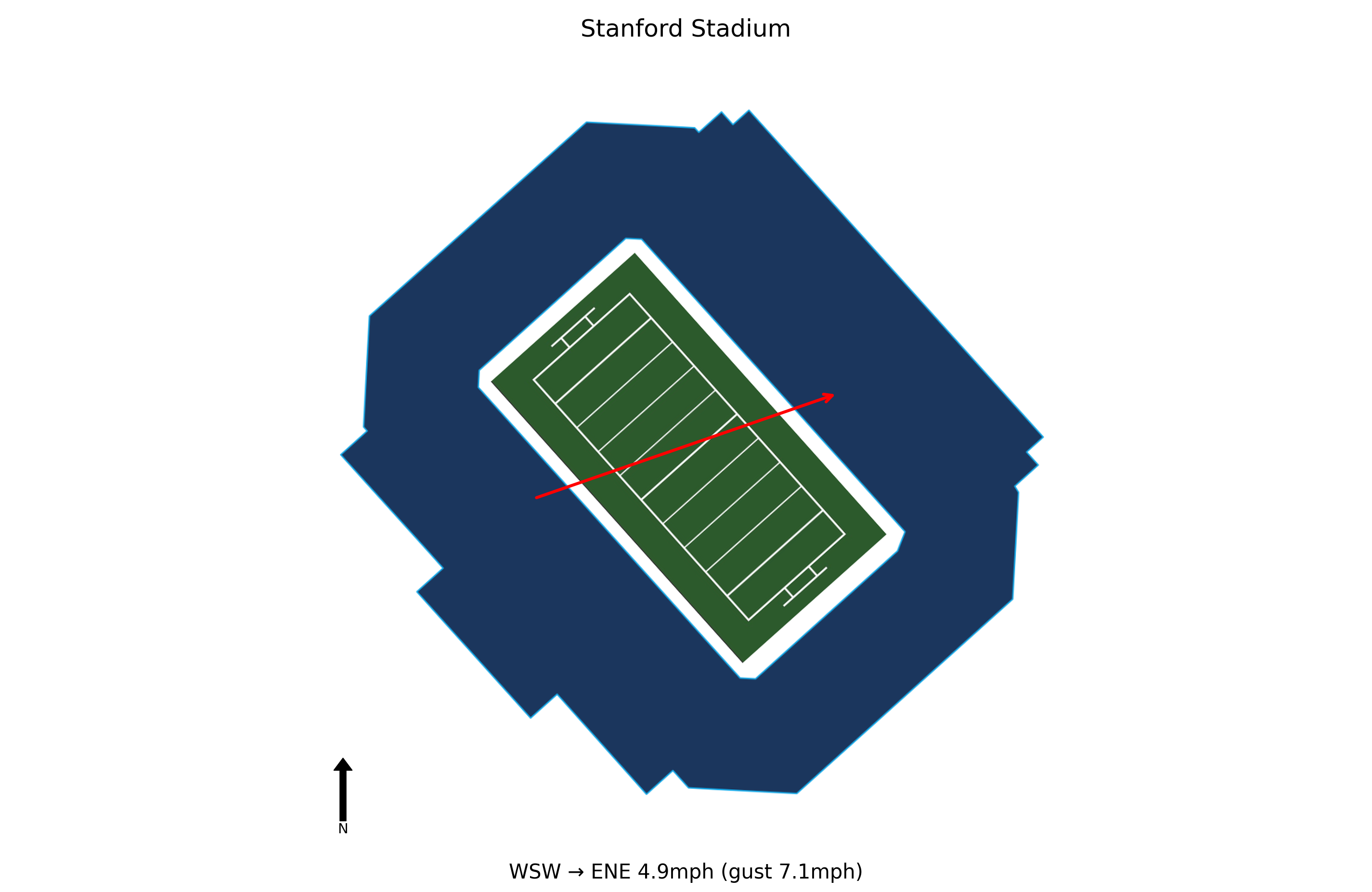
At kickoff, conditions at Stanford Stadium were Sunny, 78°F with winds of 13 mph. Weather is not expected to be a meaningful factor in this game. Historical weather data for this game is preserved in the panel alongside. Weather data is sourced from WeatherAPI.com.

Sunny
78°F
| Measure | Hawai'iAway | StanfordHome |
|---|---|---|
| This week | 2,401 miles | 0 miles |
| Last week | Season opener | Season opener |
| Season total | 2,401 miles | 0 miles |
| Body clock | 13:00 | 16:00 |
| Rest | Season opener | Season opener |


.png)


