Bovada · as of September 4, 2026
San José State defeated Eastern Michigan 27–21 in a closely contested finish. San José State covered by 9.0; Game went Under by 8.0. The market closed at Eastern Michigan -3.0 and the Blue Chip model made it Eastern Michigan -0.2, an edge of 2.8 points toward San José State.
After falling behind 35-3, the Spartans scored three late touchdowns against USC's backups, with Luke Weaver throwing for 234 yards and two scores and adding a rushing touchdown. Weaver's ability to extend plays and find open receivers against a far more talented defense suggests the offense can move the ball against Eastern Michigan, which is not in USC's class. The Spartans' pass-heavy system, which produced the nation's leading receiver in each of the last two seasons, should find more room against an Eastern Michigan defense that is not elite. This is the clearest reason to believe San José State can keep the game close or win outright.
The Spartans return only two defensive starters and are breaking in a new coordinator after allowing the Mountain West's second-highest passer rating and tying for a league-low seven interceptions last season. Key contributors like corner Greco Carrillo and linebacker Zane Carter are returning from injuries that cost them all of 2025, and the defensive line is led by Justin Stearns, who has just six career starts. Against USC, the defense gave up 35 points in the first three quarters before the Trojans eased off. Eastern Michigan, coming off a win, will test this unit with a balanced attack, and the Spartans' lack of proven depth could be exposed, especially on the road.
San José State is traveling a long distance for a Friday game after a short week, which is a genuine disadvantage, and Eastern Michigan has a modest home-field advantage. However, the Spartans are coming off a competitive showing against a top-tier opponent, while Eastern Michigan's win came against a lesser foe. The market has this close, but the Spartans' offense has shown it can score against better competition, and the travel factor may be mitigated by the team's experience playing away from home. The edge Eastern Michigan gets from the venue and travel is real but not overwhelming, and the talent gap between these two teams is far smaller than the gap San José State faced against USC.
The prediction market gives Eastern Michigan a clear majority chance to win, and the betting line has Eastern Michigan as a slight favorite. This reflects Eastern Michigan's home field and San José State's 3-9 record last year, but it underweights the Spartans' strong finish against USC, where they outscored the Trojans 23-7 in the fourth quarter. San José State's offense is a proven system that has produced elite receivers in consecutive seasons, and Luke Weaver's debut suggests the quarterback play can be better than last year's interception-prone group. The market may be overreacting to the Spartans' overall record and the lopsided final score against USC, which was closer than the margin suggests. The Spartans have a real chance to win this game, and the market's lean toward Eastern Michigan is slightly too strong.
Noah Kim threw for 279 yards and three total touchdowns against Sacramento State, and he has a full complement of returning weapons in Joshua Long, Nick Devereaux, and Harold Mack. San Jose State, coming off a loss, has not shown the secondary depth to contain a veteran quarterback with this much experience. The Eagles should lean on the pass early and often, especially if the run game with Braydon Bennett remains inconsistent as it was in the opener.
The Eagles allowed a league-high 232.1 rushing yards per game last season, and while they held Sacramento State to a modest total, the front seven is still unproven with Carter Evans as the only established starter. San Jose State, with a power rating close to EMU's, will likely test that front early to control the clock and keep Kim off the field. If the Eagles cannot stop the run, the game could stay tighter than the market expects.
The prediction market gives Eastern Michigan a solid win probability and the betting line makes them a modest favorite, but the Eagles only beat Sacramento State by 11 points at home despite being heavy favorites. San Jose State is a more established FBS program with a comparable power rating, and EMU's rebuilt defense and new running back are still question marks. The market may be overrating the gap between these teams, making the spread a closer call than the win probability suggests.
Eastern Michigan plays at home with no travel and has six days of rest, while San Jose State is also coming off a short week after its opener. The Eagles' home-field advantage is a known factor, and they have momentum from a season-opening win. However, the quick turnaround means fatigue and preparation time are limited for both teams, which could neutralize some of the home edge if the game becomes a grind.
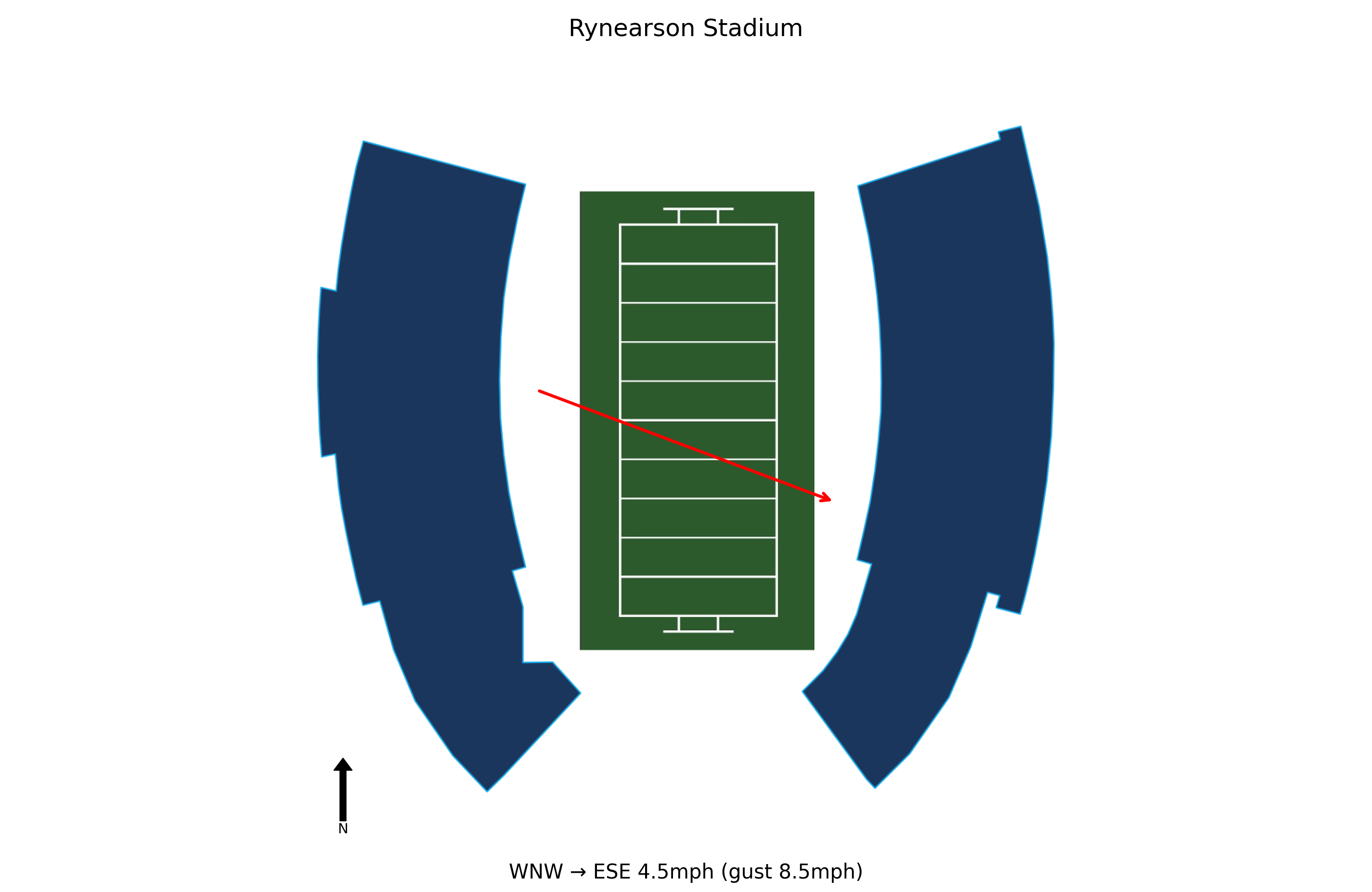
At kickoff, conditions at Rynearson Stadium were Patchy rain nearby, 82°F, heat index 88°F with winds of 4 mph. A 82% chance of rain with around 0.63 inches expected points to a genuinely wet field. Ball security and the kicking game are the exposures. Historical weather data for this game is preserved in the panel alongside. Weather data is sourced from WeatherAPI.com.

Patchy rain nearby
82°F
| Measure | San José StateAway | Eastern MichiganHome |
|---|---|---|
| This week | 2,045 miles | 0 miles |
| Last week | 608 miles | Home game |
| Season total | 2,653 miles | 0 miles |
| Body clock | 15:30 | 18:30 |
| Rest | 6 days | 6 days |


.png)


