Bovada · as of September 4, 2026
Miami defeated Stanford 45–6 in a dominant performance. Miami covered by 15.5; Game went Over by 3.0. The market closed at Miami -23.5 and the Blue Chip model made it Miami -21.6, an edge of 1.9 points toward Stanford.
The Hurricanes added Damon Wilson II (nine sacks last season) to a front that already includes Marquise Lightfoot, Armondo Blount, and Ahmad Moten Sr. Stanford's offensive line is not a strength, and their quarterback will be under duress. This should force turnovers and short fields, giving Miami's offense easy scoring opportunities and covering up any early offensive line issues.
Miami travels over 2,500 miles to Stanford for the season opener, a significant logistical hurdle. The Hurricanes have not played a game yet, and the travel plus unfamiliar surroundings could lead to a sluggish first quarter. Stanford, playing at home, will be energized. If Miami falls behind early or fails to convert early drives, the game could stay competitive longer than the market's heavy favorite status suggests.
Darian Mensah, Cooper Barkate, Malachi Toney, and Mark Fletcher Jr. form one of the most dynamic offenses in the ACC. Stanford's defense, while solid, lacks the speed to match Miami's playmakers in the open field. Expect big plays through the air and on the ground, which should allow Miami to pull away in the second half even if the start is slow.
The prediction market gives Miami a very high win probability, and the line is extremely lopsided. However, the Hurricanes are breaking in a new offensive line and traveling across the country for their first game. Stanford, despite being a weaker team, has already played a game and will be motivated. The market may be overvaluing Miami's talent relative to the situational factors, making the spread a potential trap for bettors.
Stanford led Hawai'i 23-7 entering the fourth quarter but allowed three touchdowns in a span of minutes, surrendering the lead before a late fumble return saved them. Hawai'i's quarterback threw for 269 yards and two scores in that comeback, and Stanford's new defensive coordinator Kris Richard had no answer for tempo and quick throws. Miami's offense is far more talented and explosive than Hawai'i's, with elite skill players who can stretch the field vertically. If Stanford cannot hold a 16-point lead against a mid-tier run-and-shoot attack, they are ill-equipped to contain Miami's playmakers for four quarters. This is a heavy concern for Stanford's defense.
Warren threw nine interceptions in his last full season at Michigan in 2024, and while he was clean against Hawai'i (22-for-34, 310 yards, one touchdown, no turnovers), he faced a Hawai'i defense that does not generate consistent pressure. Miami's defensive front is a different animal, with elite edge rushers who can collapse the pocket without blitzing. Stanford's offensive line, anchored by Niki Prongos, Fisher Anderson, and Simione Pale, is experienced but unproven as a cohesive unit under a new staff. If Warren is forced into hurried throws, his tendency to force the ball into tight windows will lead to turnovers that Miami's offense will convert into points. This is a significant mismatch favoring Miami's defense.
Stanford plays at home for the second straight week with zero travel, while Miami travels across the country, and Stanford has a full week of rest after their opener. Stanford's venue home-field advantage is a known factor, and the Cardinal have historically been tough at home. However, Miami is a top-tier program with a power rating far above Stanford's, and the market reflects that with a massive spread. The situational edge Stanford enjoys is worth a few points at most, but it cannot close a gap of this magnitude. Miami's talent and depth, particularly on the lines and at skill positions, overwhelm any comfort Stanford gains from playing in front of their own crowd. This point favors Miami, though the situational factors slightly mitigate the margin.
The market has installed Miami as a massive favorite with a win probability that leaves Stanford with almost no chance, and that skepticism is well-founded. Stanford needed a late touchdown and a fumble return to beat Hawai'i, a team that went winless in their previous season opener against Stanford and is not in Miami's class. The Cardinal's rebuilt defense showed systemic issues in the fourth quarter, and their offense, while productive, relied on explosive plays that may not be available against Miami's athletic secondary. The market's stance is not an overreaction; it reflects the reality that Stanford is a rebuilding program facing a national title contender. There is no reason to believe the market is wrong here, and Stanford's performance against Hawai'i only reinforces that view.
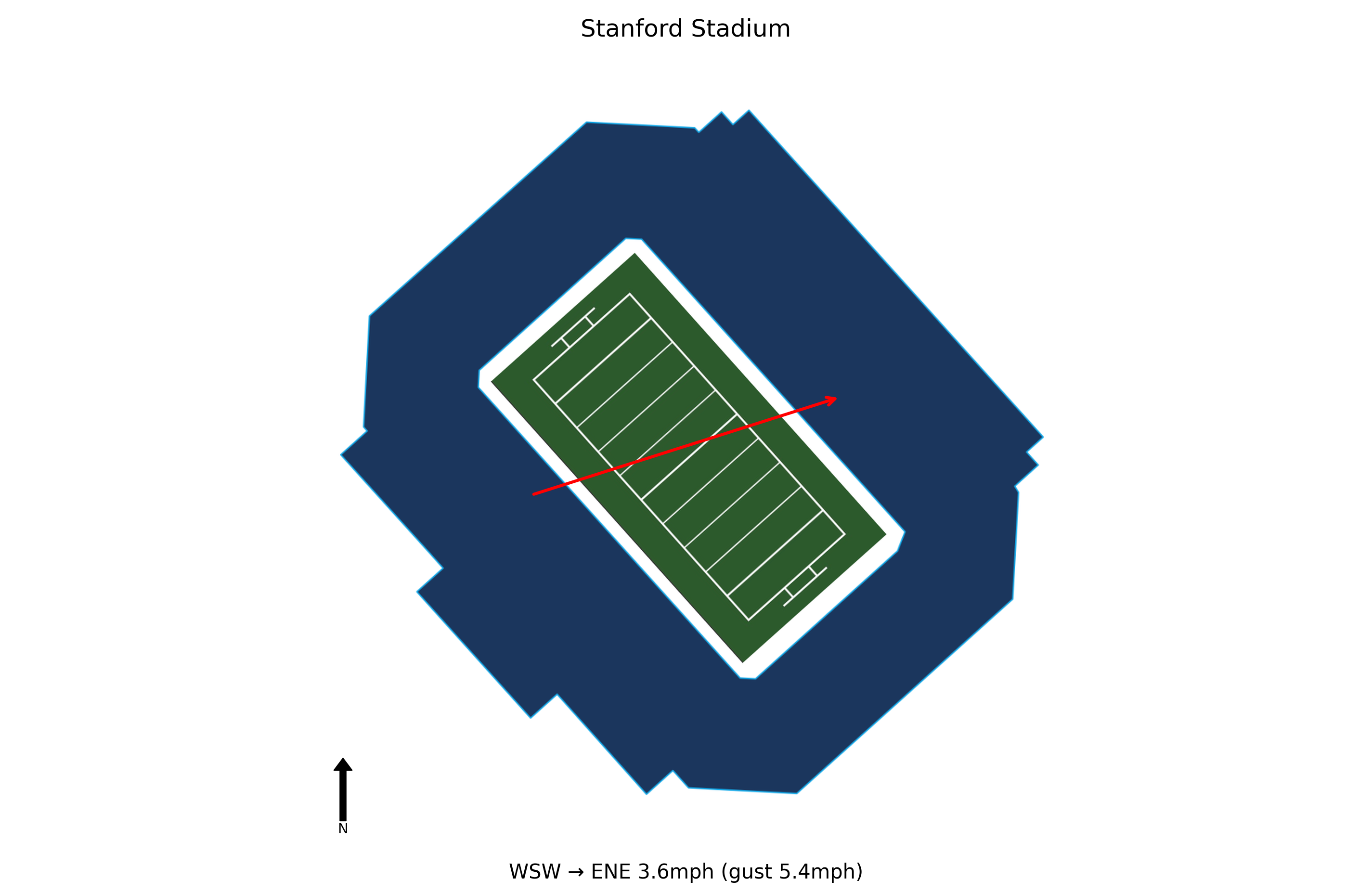
At kickoff, conditions at Stanford Stadium were Sunny, 70°F with winds of 11 mph. Weather is not expected to be a meaningful factor in this game. Historical weather data for this game is preserved in the panel alongside. Weather data is sourced from WeatherAPI.com.

Sunny
70°F
| Measure | MiamiAway | StanfordHome |
|---|---|---|
| This week | 2,569 miles | 0 miles |
| Last week | Bye week | Home game |
| Season total | 2,569 miles | 0 miles |
| Body clock | 21:00 | 18:00 |
| Rest | Season opener | 7 days |


.png)


